11/30/09

I received a letter from Corn Refiners Association


"We Read the November 18 article "Talking about Food and Farming with Orren Fox" with interest. There has been a lot of confusion about high fructose corn syrup. We would like to provide you with science-based information on this safe sweetener and be a reference for you for future articles.

The American Medical Association stated that, "Because the composition of high fructose corn syrup and sucrose are so similar, particularly on absorption by the body, it appears unlikely that high furctose corn syrup contributes to obesity or other conditions than sucrose." (Report 3 of the Council on Science and Public Health A-08, June 2008. http://www.ama-assn.org/ama/no-index/about-ama18641.shtml)"

I guess I need to do more research, The Corn Refiners suggested
sweetsurprise.com

Robyn O'Brien suggested:
Heavy Metal in our daily bread
An Open Letter

My friends at Cooking Up a Story suggested:
A conversation with KING CORN Film maker

Another Twitter friend suggested:
A WAPO article
Seattle Times article
San Francisco Chronicle
The New York Times
Does Fructose Make you Fatter? NYT
The Double Danger of High Fructose Corn Syrup

King Corn, the movie


I have to do some research about HFCS. Thought I would start here.

CLICK HERE

"Hurray for the chicken and hurray for the egg!"


From a crazy cool blog

CLICK HERE TO SEE WHOLE THING

Barn-Raising - from NYT


"Koefoed said that she has done everything backward and nothing by the book. The eggs came first: she raised them for her family on their 55-acre farm beginning in 2005 and sold some in the neighborhood. “Eventually it sort of dawned on me: Wow, this might be a nice little business.” She left her job at Havens Wine Cellars to farm full time, but things kicked in when a friend who was a sous chef at Chez Panisse took Koefoed’s eggs to work. The vibrant yolks and clean, grass-fed flavor won over the kitchen. Today the restaurant buys up to 100 dozen a week.

Then came the chickens. Alice Waters and one of her head chefs called a year into their relationship to ask Koefoed if she would raise birds for meat. “I said, ‘Nooooo!’ ” she recalled. “Then I hung up the phone and said: ‘Ugh! Of all the stupid things you have said — in your life — that may be the stupidest thing.’ ” She called back and told them she’d do it. “I was like: ‘No problem! Total breeze!’ and then the next day I ran down to the library and bookstore and bought every book I could find on pasture-raised meat birds and figured it out.”

READ ENTIRE ARTICLE HERE

Food Fight Trailer


"The subversive thing is to introduce people to things they like"

Funnny!

Food Fight - documentary


CLICK HERE TO SEE

"Food Fight is a fascinating look at how American agricultural policy and food culture developed in the twentieth century, and how the California food movement has created a counter-revolution against big agribusiness.Food Fight is a fascinating look at how American agricultural policy and food culture developed in the twentieth century, and how the California food movement has created a counter-revolution against big agribusiness."

11/25/09

"For the Love of Turkeys: A Real Thanksgiving" - from Civil Eats


.."I just always loved the beauty of them, the majesticness. I like how they strut…I love their feather patterns. I’ve always loved the personality of them. They’re so curious, so playful, so friendly and full of life….Having been around turkeys for almost sixty years, I know their vocabulary….The mother turkey is amazing to listen to. She has a tremendous vocal range when she’s speaking to her babies. And the little babies understand….Turkey’s know what’s going on and can communicate it—in their world, in their language."

READ WHOLE ARTICLE HERE

Giving Thanks for happy happy hens

An Interview with Jonathan Safran Foer

Super Silkies

Now for some awesome chickens

Live Fast Die Young


"Compassion in World Farming investigators take viewers behind the closed doors of the broiler industry. This year-long, seven-country investigation exposes the inhumane standard practices of industrial broiler farms in Europe, and presents more humane alternatives." from takepart.com

Interesting we call ourselves Civilized. Weird.

Urban Chicken Picture Show - good.is


PICTURE SHOW

YAH! Food, Inc. on Martha Stewart!!


CLICK HERE to see

11/22/09

Tips for a sustainable Thanksgiving - from Sarah Newman


wild turkey by stevevoght, Flickr Creative Commons


CLICK HERE for entire article

check out tip #5! :) (Dig Chicks)


by my friend Sarah Newman
"Since I wrote last year about tips for a sustainable thanksgiving meal, much has transpired in the food movement. We now have a First Family that regularly toils in their backyard to grow and harvest organic produce. The hit documentary, Food, Inc. was released this past year and is now in the running for an Academy Award. I had the pleasure of working on the Social Action campaign for the film which has given me the privilege of learning much from amazing food activists who are working daily in fields, offices, schools and boardrooms daily to help to build a more just and sustainable food system.

Preparing a sustainable meal can be a selfish endeavor; I guarantee you that it will be more fun, tastier and make for a good conversation at your table. However, it’s also about our global community; you’ll help to prevent the emission of greenhouse gas emissions, the slaughter of animals living under inhumane conditions, meet local farmers and help to foster the establishment of a more equitable food system through your creation of the biggest American meal of the year."

CLICK HERE FOR WHOLE STORY

11/20/09

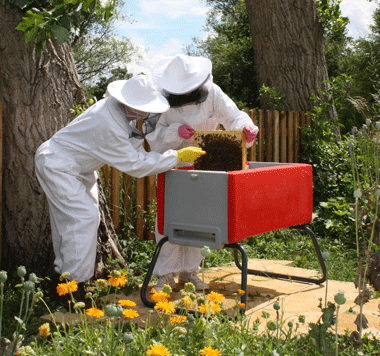
On my birthday list - beehaus (it's a beehive!)


From Omlet!

This is where I am going to put my bees

Winterizing the coop

I've been asked what I do to winterize my flock and coop. Here are a few of the things I do:

1. Add Cracked Corn to their feed. They LOVE it! and it is helps keep their body temperature up.

2. I use heated dog bowls for their water, I find them much easier to use than the heated bases and metal watering towers.

3. I wrap my the outdoor part of my coop in heavy plastic so that they can still go outside. They need as much sunlight as possible during the day. By wrapping the coop it turns into a little cozy, sunny greenhouse.

4. I add more mealworms to what I give them each day. It makes them really happy.

5. I obviously go out to the coop every day, but during the freezing times I may go more often and I inspect each bird to make sure their combs and feet are ok

6. Check for drafts and fill them.

7. I also use deep bedding
for the indoor coop. I think of it like a big blanket for them!

I think that is about it, if I remember anything else I will add it. Oh, don't worry your eggs shouldn't freeze.

Please let me know if you do something else that would be helpful to list.

Later

11/18/09

In the Field with Farmer D - MNn network


Farmer D: Hi, I am Farmer D. I am here with Charles James from Whole Foods who handles all of the compost logistics from the stores to the compost facilities and I am here with Mark McConnell who is composting here, we're outside of Athens, Ga.
And today we are here, we got a load of about 40,000 pounds of Whole Foods waste, a bunch of rotten veggies and fruit. And we are mixing and mushing and turning it into some really beautiful compost.

I want to talk to Charles for a minute here about how you get this product to us.

Charles: We gather about 50,000-60,000 pounds of the trimmings from the fruits and vegetables, all natural and organic, and we gather it up and put it in our compost bins and bring it down and do two loads weekly. We spend quite a bit of hours, manpower, you know in getting the compost picked up and getting it brought back down here.

Farmer D: Mark's been composting for a long time and is passionate about it. Mark, tell us a little bit about how you got into this, why you do it, what you love about what you do out here?

Mark: Well, I grew up with two parents that gardened quite a bit, so it was kind of in my blood, playing in the soil.

Farmer D: What would you tell a group of school kids about compost?

Mark:
It is the stuff that we came from. Compost is like the essence of life. And these thermophiles and microbes that grow in the compost take these organics in the compost and turn them back into soil and then the plants can absorb those nutrients and give us oxygen. These bacteria are processing this food waste and turning it into energy and then in that process of making soil, they are generating this heat, which we can use for other purposes: heating water or possibly even turning turbines or generating methane through anaerobic bacteria. So there's a lot of different ways that we can use this kind of energy. It doesn't belong in the landfill, it needs to go back to the soil.

Farmer D: There is no such thing as "away." You can't just throw things away. You've got to take more ownership of the earth as being ours.

Mark: You are responsible for everything you do for the rest of your life. (Laughter) That is the way I like to tell it.

11/16/09

Jonathan Safran Foer | Eating Animals Podcast

LISTEN HERE for a podcast interview

In Eating Animals Jonathan Safran Foer synthesizes philosophy, literature, science, and his own detective work in order to to explore the fictions that we use to justify our eating habits and reveals how such tales can justify an ignorance of the realities of the food industry.

Yale Sutainable Food Project


"Some observers think that a farm in the midst of a city is an odd sight. But everyone in New Haven eats, and eating, as Wendell Berry once wrote, is an agricultural act. "

Winter Harvest at Yale's Greenhouse

Winter Harvest at Yale's Greenhouse from OrganicNation on Vimeo.

11/11/09

My twitter friend @zacharycohen - Chicken Slaughter


Step 1: The Slaughter

Slaughtering is by far the most difficult part of our process. We have a great deal of respect for our animals and the sacrifice they make for us, so we try to do things as humanely as possible

CLICK HERE to read whole articl
e

He has an awesome blog HERE

What the heck is ProFood anyway? by Me..

Thank you for @JamButter, Rob Smart for asking me, I sure hope it was helpful

CLICK HERE TO READ WHOLE THING

ProFood is two words smushed together. They were smushed together by people who were trying to get across a new idea. That idea was trying to get people to think about the food we eat in a different way. Right now there is a lot of “food” in the supermarket, but not much of it is PROfood.

So, what is ProFood?

“Pro” means you are “FOR” something. For example, I am pro ethical eating. That means I support it. I believe in raising animals in a way that is humane and respectful. I’m a humane-itarian. To be ProFood means you are FOR food. That sounds funny, but what I mean is that you think about food, you care about food and you will make an effort for good food. I am also Pro chocolate and Pro Red Sox.

Also, “Pro” means professional, to be a pro at something you are the best. I am really into Pro Sports and the people who participate at the Pro level are PROfessional. They have spent a lot of time working at their sport to the point where they are the best. I’d like to be a Pro Basketball player and play for the Celtics.

To me ProFood is both of these ideas. ProFood is the very best food and ProFood is a way of thinking and acting that is “For Food”: it supports and respects the farmer who grows it, the person who picks it, the land it is grown on, the person who cooks it and the people who eat it.

Right now it doesn’t seem as if America is very ProFood.

12 Things Kids Should Learn on their Own about Food By Me

CLICK HERE TO READ

There are all sorts of really interesting things to learn about food, actually I imagine you might not have really THOUGHT about food. Maybe someone hasn’t taught you about food. Most kids would rather think about other stuff.

But just for a minute, right now, stop and ask yourself – What did I have for breakfast? Ok now, think – Where did all those ingredients come from? Who made that bagel? What time did they have to get up? Where did that egg come from? Where did the chicken live and how did it live? If you knew the animal was poorly treated would that make a difference? Or not? Where did the orange juice travel from? Florida? California? Have you ever traveled to those states? Is it a long way from California or Florida to your house? How much gas did it use to ship the OJ that far?

All really interesting questions I think.

11/10/09

Turkey Talk - by JSFoer

Talk Turkey, Start the Conversation Here

CLICK HERE


"This year as you plan your holiday meal, consider the animal that is so often at the center of the table. What do we know about it? How was it raised? What was it fed? How was it killed? Is it even possible to find these things out?

Are the answers to these questions in line with your values, your family's values and the values we are celebrating during the holiday season?

If our holiday meals are supposed to serve as a reflection of our gratefulness, can a turkey that spends its life crammed by the tens of thousands into giant warehouses, on antibiotics, that has been bred to suffer-as is true for more than 99% of turkeys sold in America-be the choice we feel best about?

This holiday season, consider the turkey. Take this conversation in any direction you'd like. The most important thing is that our choices be deliberate.

There's nothing more powerful than an informed conversation."

CLICK HERE

From Ellen Degeneres (wow it really is being talked about)

Living a Cruelty-free Lifestyle
It is obvious that in order to eat meat, an animal had to be slaughtered, but the issues of cruelty go far beyond just the death of an animal. The lives of animals raised to be slaughtered are miserable. Often packed into close quarters, many animals are unable to lie down or turn around, and the hygiene is terrible. Many slaughter methods are imperfect and cause great suffering before death.

Even animals that are not raised for food are poorly treated. Chickens that provide eggs for consumption often spend their entire lives in a cage no bigger than a piece of notebook paper, and dairy cows face abuse and mistreatment in addition to being injected with hormones to facilitate milk production. A person who wishes to live a cruelty-free life chooses to remove him or herself from any participation in this process.

Help the Environment

Farms used for meat and dairy production are incredible sources of waste and air pollution. One large farm can create more waste than the entire city of Los Angeles! The Environmental Protection Agency considers manure one of the top 10 pollutants, and US farms create 2 billion tons of it each year.

Reduce Famine
More than 70% of grain produced in the US is fed to animals raised for slaughter. In order to get just one pound of meat, it takes a full 15 pounds of grain. If this grain were given directly to people, there would be enough food to feed everyone. Also, the land that the animals are raised on can be used to grow significantly more food than the land currently provides.

Save Water

With drought-like conditions all across the country, water is getting more and more valuable. It takes 2,500 gallons of water to produce just one pound of meat, as opposed to just 25 gallons for one pound of grain.

It's Never Been Easier!
Major supermarkets are carrying more vegan-friendly options than ever before, and thanks to the Internet, you can have food sent directly to your own home. It has never been easier to make the transition to being vegan, so why not now?

Read more: Ellen Degeneres

Factory Farming on TV!


Last week, the hit Fox show BONES, featured gruesome footage (courtesy of Farm Sanctuary) of the cruelty that chickens face on a daily basis in slaughterhouses. VEGdaily contributer Jasmin Singer sums up the episode like this:

“The premise of the episode centered around a mysterious dead body that was eventually identified to be the manager at Clucksten Farms, a broiler farm at the center of a scandal led by animal rights activists. Turns out that Mr. Clucksten Manager was killed by an unhappy and underpaid factory worker in (get this) the same nightmarish way that the chickens are killed.

I don't watch this show, someone told me about it. I think it is amazing.

Starting seeds

What's with The WHO Farm? (MTV)

The Whofarm.org - AWESOME


"TheWhoFarmMobile is two school buses fused together with an organic edible garden on the roof. It was originally designed by Stefan Sagmeister and Ben Cohen of Ben & Jerry’s, built by Tom Kennedy, and named Topsy Turvy. TheWhoFarm acquired the bus, ripped off the roof and planted an organic edible garden. TheWhoFarmMobile traveled across the big country to visit schools, farms, food pantries, farmers’ markets, and festivals in 25 states and the District of Columbia in an effort to inform the nation of TheWhoFarm and our petition."

helpthehoneybees.com

Beehaus at Thuya Garden, MDI, ME

My Barred Rock dust bathing under the Lilacs.

This is from last spring. New Ducks!

This is my sweet bird Sassy, as a chick


She is so cute as a chick!

Sweet Cocoa. I buried her with some Chocolate cake for her travels.


She was a sweet sweet hen.

11/5/09

The First BeeKeeper -- AWESOME

November 4, 2009, 3:49 pm
A Bountiful Buzz
By Elisabeth Goodridge


A new type of visitor came to the National Mall this year, flitting past monuments and museums in favor of trees, flowers and plants. But this wasn’t just some horticultural tour; no, this was work. Each day they were abuzz, gathering and pollinating before returning home to modest quarters with tremendous security near Lafayette Park.

Meet the White House honeybee.

Numbering more than 65,000 at one point, the bees produced a bumper crop of honey this year, the first time honey has ever been made on White House grounds. The hive, located on the South Lawn, is a key part of First Lady Michelle Obama’s organic kitchen garden project.

The total haul was 134 pounds of honey, or roughly 11 gallons. Charlie Brandts, the White House beekeeper, couldn’t be more pleased. “I figured they would make 30 or so pounds of honey,” he said. “They surprised me.”

MORE HERE

Robert Kenner, Director Of "Food Inc," On The "Daily Show"

The Daily Show With Jon StewartMon - Thurs 11p / 10c
Robert Kenner
www.thedailyshow.com
Daily Show
Full Episodes
Political HumorHealth Care Crisis

Jonathan Safran Foer on a show called Ellen PART TWO


Jonathan Safran Foer on a show called Ellen


Anything Goes - farmfoward.com


"What the Hummer is to fuel efficiency, poultry is to animal welfare. No food in the nation produces more suffering than poultry. Factory farming had its beginnings in the poultry industry in the 1920s, and no other industry has been so altered by its methods and logic.

To make matters worse, birds raised for meat have absolutely no protection under the law. The Humane Methods of Slaughter Act is the only piece of federal legislation that offers protection to farmed animals at slaughter, and chickens and turkeys are formally excluded from the law. As a result, it’s legal—in fact it is the rule—to paralyze birds and slaughter them while they are still conscious (cows and pigs must be rendered unconscious before slaughter). This is true of free range, organic, and even pastured birds.

It’s also perfectly legal to starve birds, cut off their sensitive beaks, and confine them for their entire lives in spaces so small they can never stretch their wings. And there are currently no laws in place to prevent corporations from genetically engineering birds any way they like—regardless of the cost to the animals’ wellbeing.

Today’s chickens, for example, grow three times as fast on a third the feed when compared to heritage breeds. That abnormal growth rate has devastating effects on the birds’ health (imagine a child reaching adult size by age 7 while only eating lunch). Even more disturbing is the genetic engineering of today’s turkeys, which can no longer fly, walk normally, or reproduce sexually.

When it comes to poultry, anything goes." - from farmforward.com

http://www.eatinganimals.com/

They have a whole section on animals! - Ecorazzi.com


This site has an entire section on animals. AND one of my mom friends writes for them

CLICK HERE

11/2/09

Jan Brett (author of The Mitten) and Chicken expert


"The hen house and the rooster house have radios tuned to a classical music station "


Look what my mom found about Jan Brett's Hens! She said I could visit her and she would help me with my hens. Chicken people are cool.

From NYTimes