6/23/11

Nat Geo - Heirloom Chickens


"People eat more eggs and poultry than ever, but the world’s reliance on a few high-yielding breeds is edging out hundreds of others: Nearly a third of chicken breeds are at risk of extinction. That’s alarming because many varieties have traits, like heat or pathogen resistance, that could be invaluable in the future."

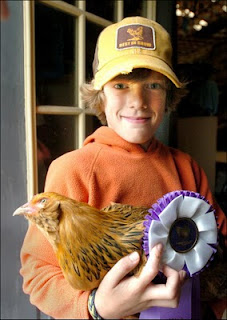
I have a speckled hamburgh bantam, her name is Messy or Eunice. Depends on the day.

Thanks to my friend @sarahnow for the heads up.

New honey, uncapped.


Picture by my brother Will

Queen of the Sun Trailer


"beekeepers are chosen by the bees"

6/17/11

"This I Believe" writing for school.


I believe in the power of women.

I work for around half a million of them every day, and they work for me. I am their caretaker, and they are my workers. A few thousand of them are the best engineers you have ever met. Another couple thousand are the best nurses you have ever heard of. Four of them are the best mothers ever to live, and the remaining thousands are the best gatherers and guards that the world has ever seen. They are unselfish and put their thousands of sisters before themselves. If there is a threat to their house, they will die in battle to deter the threat away. Of the thousand sisters, they have only a few hundred brothers. The brothers do not guard, clean or help any of their siblings’. All they do is consume the hard work of their extraordinary sisters. From the second these amazing ladies are born, they begin their work. This is the intriguing story of a honeybee.

When I first became a beekeeper, after four months of bee school, I realized the true power of an insect that can save the world. On mothers’ day last year, I installed my first package of bees. This was my first experience having hundreds of bees less than an inch from my skin. I became comfortable with these little insects as they crawled under my suit and started crawling on my stomach. I was unaware that honeybees are experts at finding and climbing into little holes wherever they can. As it turns out, they had found the bottom of my pant leg on my bee suit, and started crawling in. Honeybees are not meant to sting you. They are meant to pollinate and create honey. Anyway, these bees had started crawling up my leg and onto my stomach. After a couple of nervous moments, I calmly walked away from the cloud of bees and unzipped my suit. When I lifted my shirt, I found 10 baby bees clinging to my chest. I gently wiped them away, trying not to hurt them. I returned to my hives unharmed.

This was a good beginning to my hives. Now when I walk through the woods, and come the area where my bees are nestled into a little pocket of trees, I know that when I lift the top of a hive, I will be looking down at a family of the hardest workers I have ever encountered. These women are pretty powerful. We need them to survive. Plants need them to survive, and the planet needs them to survive. They might be the most powerful women in the world. Queen Elizabeth and Oprah are some very significant women, but nothing compares to the little insects who pollinate the planet. This is why I believe in the power of women.


This I believe.

6/11/11

My Broody Hens


For the first time in the five years of raising birds, I have had some truly broody hens. In years past, I have had birds who merely sit on the eggs for a couple of days and never hatched any. I think this is about to change. For around a week now, two of my hens are broody on about a total of a dozen eggs. Butterscotch, my Americana, is sitting on top of some fertilized silkie eggs coming from a pair of silkies in the barn. Whenever someone approaches her or walks past, she ruffles her feathers to look larger and makes a sort of growling noise. Yes, a growling noise coming from a hen. Before Butterscotch, my little girl duck, Olive, was sitting on as many eggs as she could. She is a bantam Call duck (she is very teeny), which leaves her not many feathers to cover all of the eggs. She would also guard her eggs and when I came near hiss at my hand and sometimes pecking it whenever it got too close. Interestingly after two days, a broody Blue Cochin, Sassy, kicked Olive out and claimed the eggs to be hers. She also plucked all the feathers off her chest to expose her skin to the surface of the eggs. Instead of fighting it, and maybe causing more harm to Olive, I let the birds decide who sat on the eggs and it happened to be Sassy. She has been a very consistent mother, always sitting on her eggs and never going too far away from her eggs. To help both of my broody hens out, I put a bowl of food and a full waterer within a foot of their nests. This allows them to have food and water and not let their eggs get chilled while they are eating. This is hopefully the first time that my own birds will hatch their own eggs and raise a family.

The tricky thing about broody hens is that if the eggs aren't really going to hatch they can stay broody for too long. I have even heard of hens that died while broody. Their body temperature rises when broody and they can get "too comfortable". If the eggs are fertilized cool, if not you are going to help her get "un-broody" (is that a word?)


TIPS:
1. Put water and food nearby

2. Keep her in a quite safe place, unbothered by other hens

3. A set of eggs will take approximately 21 days til hatch out.

4. If you don't want them to be broody, simply take them of the nest and keep them away from that spot for 24+ hours. And remove the eggs from the nest.

5. Don't let a hen go longer than 21 days.

6/10/11

Pecking Order (My first blog post, 5 years ago)


Sweet Butterscotch after healing.

Our sweet hen, Butterscotch is at the bottom of the pecking order and was quite injured as a result. "The pecking order is a well-defined hierarchical pattern of behaviour that manifests in flocks. There is a ‘top bird’ to which the rest will defer, often giving way at the food container or generally getting out of the way. The top bird is often a cock, but in the absence of a male, an old hen may hold the position. She may continue to hold sway even if there is a male, if he happens to be young and nervous. The pecking order extends downwards (just as it does in human societies), with the weakest having to survive as best as they can, dodging the onslaughts of the more powerful. The pecking order may also extend sideways, with a previously untouched bird being attacked if, for example, it becomes ill or sustains a wound that attracts the unwanted attention of the other birds."

When we initially took her to the vet where they recommended that we put her down, the injury was too deep. We decided not to do that but to try and nurse her back to health as best we can. The vet washed, cleaned and trimmed some feathers then made a little cone to put around her neck so she wouldn't get into a bad habit of picking the injury. We are also now giving her some antibiotics to help prevent infection. We have built a new little ccop for her, near her old flock but separated. I think she may never go back in with her old flock. So far it seems to all have worked, she even laid an egg yesterday.


Tips for helping birds at the bottom of the pecking order 

1. Give your birds plenty of places to perch. This allows for those birds near or at the bottom to get away from their attacker.

2. Don't let your birds get bored.

3. If the bird at the bottom of the pecking order has a wound that is bleeding, it will (oddly) attract the attention of all the hens. They will be curious about it and often will begin to peck at it too.

4. Best bet is separate this bird from the flock, put her in the infirmary and let her heal. In my case butterscotch got her own coop near the the other hens and never returned to the original coop.


6/8/11

Lice.

People often ask me about lice.

Here is how you can tell if your bird has lice:
a drop in egg production
broken feathers
raw patches
wattles looking pale (lice cause anemia)
look near the vent to see if you can see them


1. Humans cannot get chicken lice!

2. Keep your coop very clean. I try and completely clean the coop every week.

3. Don't use hay in the nesting boxes. The lice live and rest inside the tube of the hay. Hay is a breeding ground for lice. Straw is ok, but hay is not.

4. Overcrowding promotes lice growth. Each bird should have roughly six square feet.

5. If any birds from outside the flock are coming into the coop, check them very carefully before introducing them to your flock.

6. Make sure your birds have a place to dust bathe (I use a mixture of sand and dirt). This is how they naturally take care of lice. They fluff up their feathers and dust the dirt onto their skin and lice.

7. I sometimes sprinkle a little food grade diatemaceous earth into the area where they dust bathe, DE is thought to be a natural solution for lice. I always wear a mask when working with DE.


Hope this helps.

6/3/11

Cheesecake. 5 years ago

Student finds passion for activism - Beverly Citizen

By Katrina Powell, June 9, 2011

Stella is a social butterfly, Alice is a chatterbox and Paprika acts as the boss lady, keeping everyone in line. While these may sound like the personalities of characters on a television series, they are, in fact, chickens.

Orren Fox, an eighth-grader at The Glen Urquhart School in Beverly, owns 23 hens, three roosters and four ducks and claims that they have as much personality as domestic pets like cats and dogs.

“They all have really funny personalities and it’s fun to see them interact with one another,” said Fox said, who lives in Newburyport.

Fox, 9, initially acquired a batch of 12-day-old chicks from a gardening and agricultural store back in 2007, and was instantly intrigued by the birds.

“I’m not sure what got me interested, but one little thing just sparked an interest inside me,” Fox said.

“My husband and I certainly didn’t know the first thing about birds when he brought them home,” said Fox’s mother, Libby DeLana. “But there’s nothing like seeing your child so engaged in something.”

Fox was in forth grade when he first brought home his birds, and despite his young age, he rose to the occasion and took on the responsibility of raising and caring for his young pets. Fox explained that the birds started out as clueless chicks and he was responsible for showing the babies how to find food and water. He now spends about a half hour each day after school feeding the full-grown chickens and providing them with clean water, as well as sweeping their cages and collecting eggs.

“It sounds like a lot of work, but once you do it everyday for years, it just becomes something you do,” Fox said.
The birds have a cozy home within three large cages that are set up inside the family’s barn, and some birds just run free inside the barn, Fox said. It’s safe to say these chickens won’t be flying the coop anytime soon.

“They definitely have plenty of room and they’re pretty happy,” Fox said. “You should have a minimum of five square feet per bird.”

A year after receiving the chicks, Fox entered the fifth grade and learned that his class at Glen Urquhart required a research project. Because of his love for his pets, he chose to conduct his project on, what else, chickens. But when he began to conduct the research for the project, Fox didn’t like what he found out.

“What really caught my eye was the egg-laying business,” Fox said. “I discovered that most factory farms will cram eight birds into an 18 inch by 18 inch cage with little food and they are literally clawing each other’s backs because there is no room. It’s really a miserable situation.”

Fox added that chickens will lay the majority of their eggs within their first year of life, and after that time, the chickens are sent to the chopping block. Another unsettling area of research for Fox was what he found on the birds that are raised primarily for meat purposes.

“The get treated so badly and they are injected with hormones and steroids,” Fox said.

Fox explained that after opening his eyes to the inhumane treatment of chickens, he knew that he was doing the right thing by raising his own chickens.

“My own birds will never have to go through that,” Fox said. “Chickens felt great as pets but then I really realized that I was doing something really good by keeping them away from bad treatment.”

Fox has been featured on NPR, Time for Kids, Ranger Rick and Yankee Magazine for his research, and even discussed his knowledge with the masses during a seminar that was held in May at his school called Greenspiration. The seminar was attended by approximately 40 people, and featured stations where students and parents could learn about gardening, farming and agriculture. Fox’s personable chickens were also in attendance.

“It was a fun little event for people to learn how to start something sustainable in their own backyard,” Fox said. “I think it was really successful.”

“The Glen Urquhart School is so incredible,” DeLana said. “To be honest, it’s amazing for a child to be able to be interested in something, anything, and no matter what it is, the children are open to it and think it’s cool.”

Although the research started out as a school project on raising chickens, it quickly evolved into a full-time commitment for Orren, as he decided to start a blog and Twitter page in 2008 to share his information with the masses.

“It just started as a hand-written journal but people then wanted to know what I was writing and they had questions about their own birds,” Fox said. “I’m now just trying to spread the word [about inhumane treatment] so that people will get their own birds and raise them in their backyards.”

Today, Fox has a blog readership and more than 3,000 followers on Twitter (@happychickens), with whom he shares his knowledge and opinions on the humane treatment of chickens and other animals, healthy eating, and the environment.

“It’s really nice to know that what I’m writing is read by a lot of people,” Fox said. “It motivates me to write more.”

Fox tries to update his blog several times a week, adding interesting articles about the subject and even pictures of his own chickens. Fox explained that it doesn’t take much to make a difference.

“Not a lot of people know about how badly chickens are treated but it’s important information to know,” Fox said. “It just a simple little thing of treating some birds nicely. I think that if I can treat some chickens nicely, it’s better than none.”

Fox added that chickens that are raised in a comfortable setting will lay eggs that taste much better than if they are raised on factory farms. He explained that if people are unable to raise their own chickens, they can still promote humane treatment by purchasing eggs from a local farm, and finding a local supplier of meat where the animals are ethically raised.

“I would say that if you feel happy about supporting the way that the animals you eat are treated, then I would continue to buy from that supplier,” Fox said. “But if you aren’t happy about how they are treated, then I would do something about it.”

Sweet Blue Cochins. They are the best.


The Chicken Chronicles -


"I love this chicken because she is so in her body. If you look into her eyes you are right to know she is not thinking of your dinner.

One of the things I especially prize is that she is missing a toenail. At first I wanted the artist to put on a fake one, but then I thought no: Life gives us broken toenails and worse to let us remember where we’ve been and the struggles we’ve overcome. I felt this way a few months ago watching How To Train Your Dragon, a movie I like a lot. One of the things I like about it is that the main character Hiccup loses a leg in his battle to save his dragon friends and enlighten his Viking community. This is the truth of Life. We may lose a lot in whatever fight we choose or have chosen for us. But these are warrior marks and need not be hidden or completely disappeared by “restoration.” The lessons from them in their role as teacher never end, and seem to me, having acquired a few deficits myself, to become more like oddly delivered gifts. Gifts that it becomes easy to imagine The Universe (in the form of ancestors or whoever they are) sending down to us. Weeping as they pray we can outlive the initiatory pain.

What I didn’t like so much about How To Train Your Dragon (adored the matriarchal choosing of leaders, of course!) is that at the end the Vikings are shown playing with the dragons by having the dragons fly them about. The question is: what do the Vikings do for the dragons?

Anyway, this is the book that grew on this blog, as I sat with my chickens in the outback of Mendocino, California. I sat with them expecting nothing and over the months they pecked open places I hadn’t been able to enter by myself. All of my “girls” have their toenails but occasionally, and though it is shocking it is natural, they lose their feathers."

More here

The Diane Rehm Show The Chicken Chronicles

Alice Walker blog

Sweet! CONGRATULATIONS TO MY FRIEND TAMARA STAPLES! on the cover photo

Pinterest