
5/31/11


Queen Bee.
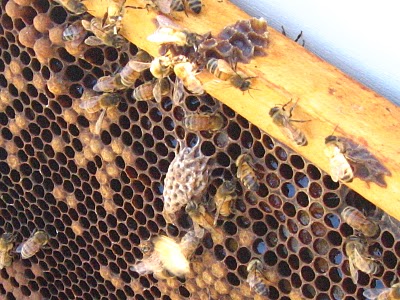
This weekend was totally exciting because I was checking on my big green hive and found some supersedure cells. I pulled one off thinking that the queens had already moved into the hive to battle it out with the other queens, but no she was still in the cell and she hatched right on my hand. It was amazing. Honestly I was so surprised I didn't really know what to do. I decided that if I hadn't (mistakenly) taken her out of her spot she would still be in the hive, so I put her back in. I think there must have been a battle that night. Only one queen can survive. If I had been preparaed I probably could have split the hive. But. I. Wasn't. I imagine that hive will swarm.
Lots to learn.
Lots to learn.
5/23/11
READ "Animalish" - by Susan Orlean

Susan Orlean, with Mabel Black Label, an Araucana chicken
At Home on the Farm and in E-Books
By JULIE BOSMAN
Published: May 18, 2011 PINE PLAINS, N.Y.
Last Friday Susan Orlean was on the verge of some serious animal acquisitions. Her latest herd of 12 Black Angus cattle was scheduled to be dropped off within days. And the local post office could call at any minute to report that four rare and eye-catching Swedish flower hens were ready for pickup, having been shipped overnight from Florida. READ ARTICLE HERE
Find Animalish here
Find Animalish here
Greenspiration Event at School

By Sean Teehan, Town Correspondent - Boston.com
Orren Fox, an eighth grader at Glen Urquhart School in Beverly, eats eggs for breakfast most mornings. If for nothing else, it helps cut down on the surplus that comes with owning more than 20 chickens.
"I look at the eggs as a bonus, a very delicious one," Fox said in an interview.
On Saturday Fox will inform people of proper chicken care and other chicken-related matters at the Glen Urquhart School Greenspiration where students will also have displays dealing with gardening, agriculture, and other environmental matters.
Fox has been a proponent of ethical chicken treatment since he began volunteering at a farm about a mile away from his Newbury home when he was 9-years-old, he said.
"I'm not sure [why], but something struck a cord with me and really made me want to learn about chickens," Fox said.
As he made daily trips to the farm, Fox soon yearned for some chickens of his own. In 2007, he got his first dozen chickens at Agway in Danvers, he said.
Since then, his assembly of pet poultry has grown.
"It would be safe to say I have 23 hens, three roosters, and five ducks," Fox said.
Each day after school, Fox goes to the farm about a mile away from his home where his chickens and ducks live in a barn to provide them with food as well as meal worms and scratch feed as treats.
When one of his birds is injuredfeeling under the weather, he brings them to the local veterinarian, he said.
"There are occasionally interesting receptions when I come into an animal hospital with a squawking chicken or a duck," Fox said.
His pets have also earned him some money, Fox said. With hens lay a total of about nine eggs each day, Fox began putting them in cartons on which he puts a custom "O's Eggs" stamp and puts them in a refrigerated cooler outside his house. Neighbors, who can name their own price, often leave $5 for a dozen, Fox said.
Although many people opt for cats, dogs, or other animals often found at pet stores when choosing a pet, Fox said despite popular perceptions, chickens are more than just food.
"I think they're truly underestimated because people think that birds don't have personalities," Fox said. "But really, some of them have more personalities than any dog or cat."
Fox has been a proponent of ethical chicken treatment since he began volunteering at a farm about a mile away from his Newbury home when he was 9-years-old, he said.
"I'm not sure [why], but something struck a cord with me and really made me want to learn about chickens," Fox said.
As he made daily trips to the farm, Fox soon yearned for some chickens of his own. In 2007, he got his first dozen chickens at Agway in Danvers, he said.
Since then, his assembly of pet poultry has grown.
"It would be safe to say I have 23 hens, three roosters, and five ducks," Fox said.
Each day after school, Fox goes to the farm about a mile away from his home where his chickens and ducks live in a barn to provide them with food as well as meal worms and scratch feed as treats.
When one of his birds is injuredfeeling under the weather, he brings them to the local veterinarian, he said.
"There are occasionally interesting receptions when I come into an animal hospital with a squawking chicken or a duck," Fox said.
His pets have also earned him some money, Fox said. With hens lay a total of about nine eggs each day, Fox began putting them in cartons on which he puts a custom "O's Eggs" stamp and puts them in a refrigerated cooler outside his house. Neighbors, who can name their own price, often leave $5 for a dozen, Fox said.
Although many people opt for cats, dogs, or other animals often found at pet stores when choosing a pet, Fox said despite popular perceptions, chickens are more than just food.
"I think they're truly underestimated because people think that birds don't have personalities," Fox said. "But really, some of them have more personalities than any dog or cat."
5/22/11
When do I switch to Egg Layer from Grower?

My blue cochins. When this picture was taken she was eating "Grower"
"When do I switch from Grower to Layer?"
I feed my babies "Starter" until about 8 weeks.
Then I switch to "Grower Mash" until they are fully "feathered out" about 20 weeks.
Next I switch them over to "Layer Pellet" I do not use "Layer crumble or mash".
I also mix in some:
Black Sunflower Seeds
Cracked Corn
Flax Seed
Mealworms
GameBird Pellets (higher in protein)
There are lots of ways to feed your birds. This is just one suggestion.


"My hens got eaten by __________"

Here is my hen dust bathing next to barn. I am always with them when the are out of their coop.
I have heard one to many times these last few weeks about people losing hens to neighborhood dogs or other predators. Now I understand no one intends for this to happen, in fact most people are taking very good care of their hens. But your number one priority is to keep your hens healthy and safe. "Free Range" backyard hens are NOT safe if you just let them roam about with no protection. Actually your neighbors dog can't help himself! It is your responsibility to keep your coop predator safe and your hens/roosters safe.
One person said to me "we lost several last week to a neighbor's dog" he frowned. I asked "what did you change to prevent this from happening again?" No response. A few minutes later "our hens are outside roaming in our backyard for bugs and grass right now" he said as if he were doing them a favor. "But you aren't there to protect them" I gently said. No response. I hope they are all safe. Honestly I'm sure he is doing what he thinks is right. I respect that, and obviously just being with your hens doesn't gaurentee that they will be safe. I just ask, make the effort.
I had someone else say "How do you keep the predators out of your coop?", well I have chain link fence that goes about 20 inches into the ground with big telephone pole type things where the fence meets the ground, the coop also has a tin roof so no hawks can get in and I never leave them alone outside in the field unless I am there, or the farmer I work with is there with her dogs. I never leave them alone. They are too vulnerable.
I don't want to make anyone feel bad. Would you ever put other animals you cared about in the same pasture as the animal above it on the food chain? I know that even my method doesn't mean my hens will be 100 percent safe. Just think about it.
Please, take care of your animals. Protect them. Keep them healthy and happy otherwise honestly you are simply feeding them to other animals. Keep your hens safe.
5/17/11

5/4/11


5/1/11

Subscribe to:
Posts (Atom)